July’s Quiet Index Hid a Violent Market

The S&P 500 barely moved. Underneath it, an energy shock, an AI reckoning and a sudden return of stock-picking redrew the leadership map.
July ended with the S&P 500 almost exactly where it began. That is the least useful fact about the month.
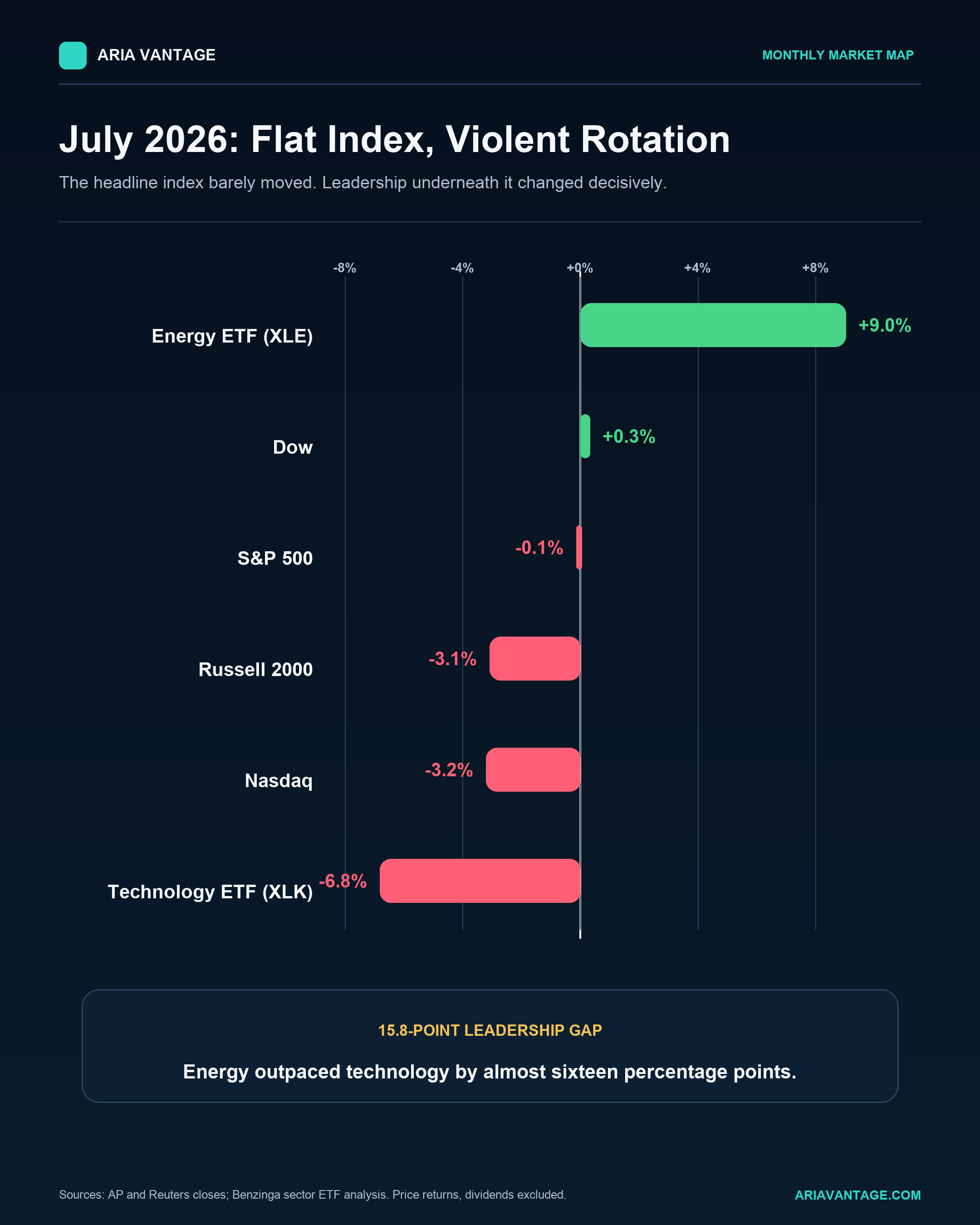
The index slipped roughly 0.1%, from 7,499.36 on June 30 to 7,489.72 on July 31. Yet the Nasdaq Composite fell 3.2%, the Russell 2000 lost 3.1%, and the Dow edged up 0.3%. Those small headline changes concealed a historic argument inside the market: whether the next dollar belonged in expensive AI infrastructure or in the companies that move fuel, goods, payments and real-world production.
By month-end, the answer was no longer “AI at any price.” It was “show us the return.”
The month in one chart
The month’s defining spread was between energy and technology. The Energy Select Sector SPDR Fund gained about 9% during July while its technology counterpart fell almost 7%, according to Benzinga’s sector analysis. Brent crude, meanwhile, careened between $72 and $102 before settling July 31 at $87.93, according to the Associated Press.
That volatility changed the entire discount-rate conversation. The 10-year Treasury yield finished at 4.71%, up sharply from 3.97% before the Iran war sent oil higher. More expensive energy threatened stickier inflation; stickier inflation reduced the market’s room to expect lower rates; and higher yields punished long-duration growth stocks.
What drove the market
Three forces kept trading control of the tape.
First was the Strait of Hormuz. Shipping disruptions and attacks on commercial vessels turned a geopolitical risk premium into a physical-market problem. Oil and refining shares benefited while airlines, transport-sensitive businesses and rate-sensitive assets absorbed the pressure.
Second was the AI capital-spending debate. Investors did not abandon artificial intelligence. They became less willing to accept spending as proof of value. The chip complex entered July after a parabolic first half, then suffered a brutal positioning unwind. On July 28 alone, Micron fell 8.9%, AMD 8.1% and Applied Materials 7.8%, while South Korea’s Kospi dropped 10.8%. Morningstar analyst Jing Jie Yu told the AP that the market appeared spooked by progress in China’s chipmaking-equipment capabilities, though he viewed the reaction as overdone.
Third was earnings. Microsoft and Amazon delivered evidence that AI demand was translating into cloud growth and profit, and their shares were rewarded. Apple beat on profit but fell 7.4% on July 31 after a weaker-than-expected revenue-growth outlook and component constraints. The market’s verdict was precise: capital intensity is acceptable when revenue, margins and cash economics keep pace.
The rotation
July was not a simple “risk-off” month. It was a rotation away from the most crowded winners.
Energy, refiners, financial-market infrastructure and selected business-services companies led. Technology, semiconductors and several former momentum darlings lagged. That helped equal-weight and value-oriented parts of the market look healthier than the cap-weighted Nasdaq would suggest.
The best-performing S&P 500 stocks for the full month included Cognizant (+35.8%), PayPal (+31.4%), Accenture (+31.0%), Willis Towers Watson (+27.3%) and Intercontinental Exchange (+26.0%), according to StatMuse’s July screen. Valero gained 18.5% and Microsoft 18.5%, showing that the winning side of the market was not one-dimensional.
The worst performers were Corning (-43.5%), Sandisk (-38.6%), KLA (-36.8%), Marvell (-35.1%) and Generac (-33.4%). Tesla fell 26.7%, Applied Materials 24.9% and Micron 19.2%, according to the corresponding StatMuse laggards screen.
These lists are price-return screens, not recommendations. Their real message is that July reversed many of the first half’s most crowded exposures.
The top stories
Hormuz became a price, not a headline. The war pushed crude, gasoline, freight and insurance costs higher. U.S. regular gasoline averaged nearly $4.11 by month-end, up from $3.85 a month earlier.
The Federal Reserve held rates steady. Chair Kevin Warsh reiterated the 2% inflation objective but left investors uncertain about the path. The bond market supplied its own answer by pushing long yields higher.
AI’s burden of proof rose. Microsoft’s best day since 2008 and Amazon’s 15.3% post-earnings jump showed that investors still pay for convincing growth. The collapse in memory and semiconductor momentum showed they will no longer pay indiscriminately.
Market breadth improved, but not cleanly. The Dow held up and many non-tech groups advanced, even as the Russell 2000 lost ground. This was rotation, not a universal broadening.
The questions investors carried into August
Is the AI trade over? No. The market is separating AI beneficiaries with visible revenue and operating leverage from companies priced on capacity scarcity alone.
Is energy leadership durable? It lasts while constrained shipping, refining capacity and geopolitical risk keep crude and product markets tight. A credible reopening of Hormuz would remove part of that premium quickly.
Will the Fed hike? July’s oil shock and higher long-term yields increased the risk, but the answer will depend on inflation expectations, labor data and whether energy costs broaden into core prices.
Was July’s semiconductor selloff healthy? In part. Momentum had become extreme. But a healthy correction can still expose weak financing, concentrated portfolios and business models whose valuations assumed uninterrupted scarcity.
What matters next? Cloud growth, free cash flow after AI spending, tanker traffic through Hormuz, the 10-year yield and the gap between cap-weighted and equal-weight performance.
July did not kill the bull case. It forced it to grow up. The market still wants growth—but now it wants receipts.
Data are through the July 31, 2026 close. Price returns exclude dividends unless noted.
Disclosure: This article was partially produced with the assistance of AI tools and was reviewed and edited before publication. The author held long positions in AMZN, AAPL, MSFT, MU, XOM, CVX, VLO, NVDA, TSLA, CAT and PSKY as of July 31, 2026. The author received no compensation from the companies mentioned. This material is for informational purposes only and is not investment advice.