The China–Iran Missile Report Tests Pakistan’s Two Roles

Reuters says Iran expects Chinese-made shoulder-fired air defenses routed through Pakistan. Beijing and Islamabad deny the account. Washington should neither dismiss the intelligence nor outrun the evidence.
A reported arms route from western China through Pakistan to Iran would be strategically significant for three reasons: the weapons, the timing and the contradiction at the center of Pakistan’s role.
On July 29, Reuters reported that Iran is expected to receive within weeks the first shipment under a contract for 300 to 400 Chinese-made man-portable air-defense systems, or MANPADS. Three sources familiar with the deal put its value at $60 million to $70 million and identified QW-12 and FN-16 systems.
The same sources said deliveries were planned to originate by air from Urumqi in western China, transit Pakistan and enter Iran, though they did not specify whether the Pakistan-to-Iran leg would move by road or air. They cautioned that schedules, quantities and implementation could still change.
China called the report “completely groundless.” Pakistan’s military public-relations wing said speculation that Pakistan was involved was “absolutely concocted and false.” Iran did not immediately comment.
Those denials belong in the first screen, not the footnotes. So does the fact that Reuters relied on unnamed sources with direct knowledge and identified an alleged intermediary: Hong Kong-based Zhongqing Baoshang International Investment. The parent company did not respond to Reuters’ request for comment.
What is reported, denied and still unknown
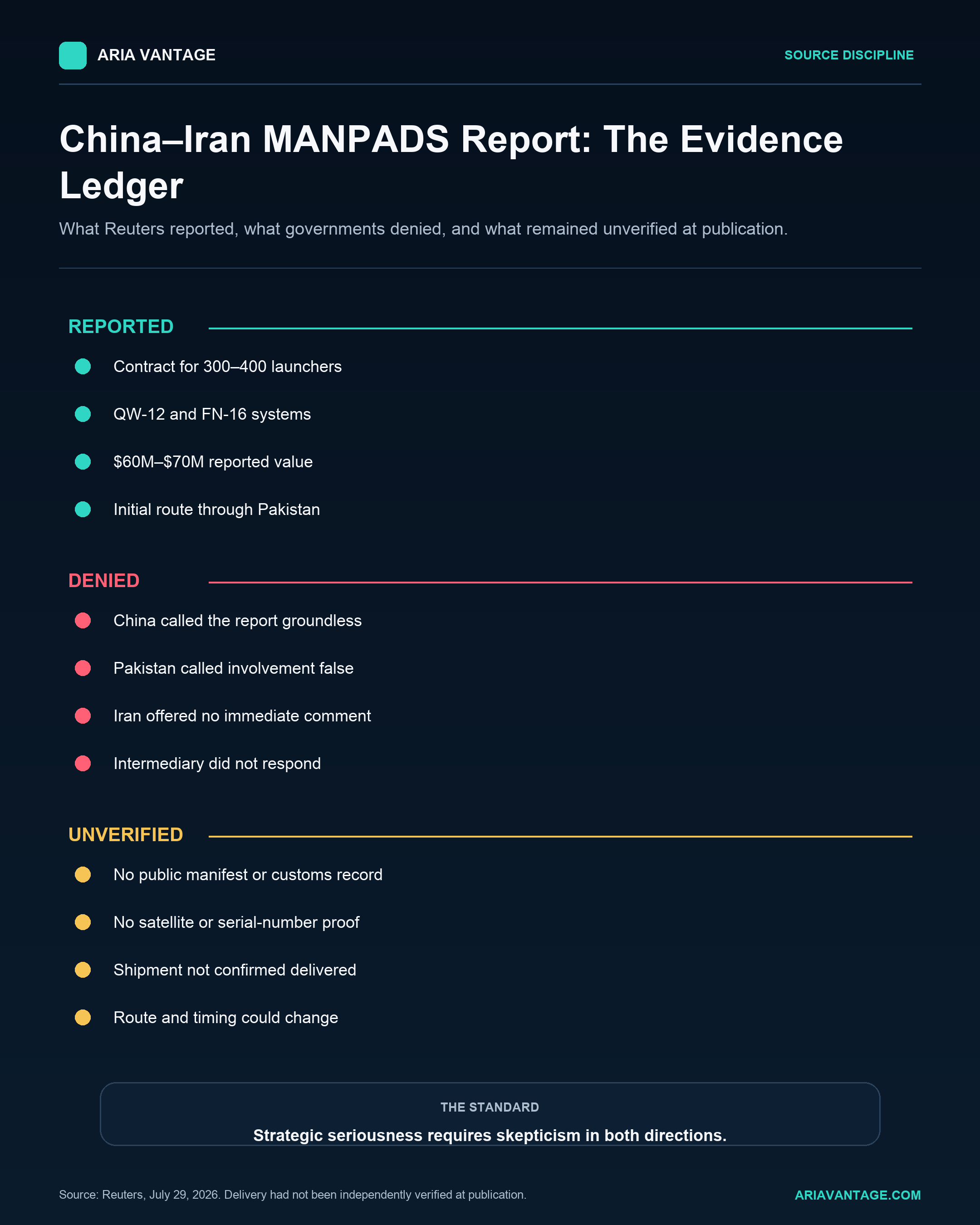
Reported by Reuters: A signed contract covers 300–400 QW-12 and FN-16 launchers; a first shipment is expected within weeks; and the initial route is planned through Pakistan.
Officially denied: China rejects the report. Pakistan denies involvement in supplying air-defense weapons from China to Iran.
Not yet publicly verified: No shipment manifest, customs record, satellite image, serial-number evidence or on-the-ground delivery confirmation has been published. Route and timing may change.
Previously reported: In April, U.S. intelligence assessments cited by CNN indicated China was preparing to deliver air-defense systems to Iran. Beijing called similar reports “baseless smears,” and President Trump said Chinese President Xi Jinping had assured him China was not supplying Tehran. Reuters also reported earlier talks over possible Chinese anti-ship cruise missiles.
The July report is therefore not an isolated rumor. It is a new, more specific allegation in a chain of reports and denials. Specificity increases its intelligence value; it does not convert it into verified delivery.
Why MANPADS matter
The QW-12 and FN-16 are infrared-guided, shoulder-fired surface-to-air systems designed for low-flying aircraft, helicopters and drones. They do not replace long-range air-defense batteries. Their advantage is mobility.
Small teams can disperse the systems, conceal them, relocate quickly and defend selected military sites, energy infrastructure or command nodes. That makes them harder to eliminate than fixed batteries and raises the operating risk for aircraft and drones at lower altitude.
The proliferation concern extends beyond the conventional battlefield. Portable missiles are easier to divert, transfer or lose control of than large systems. Any deal involving hundreds of launchers would require scrutiny not only of the buyer but of custody throughout the route and after delivery.
China’s parallel Houthi diplomacy
The arms report arrived one day after a separate Reuters investigation said China had held direct talks with Yemen’s Houthis to secure safe passage for Chinese tankers through Bab el-Mandeb.
Six sources told Reuters that Beijing sought vessel-by-vessel assurances after the Houthis threatened shipping connected to Saudi ports. At least four tankers carrying Saudi crude to China transited after the restrictions were announced. Reuters reported that the Houthis’ media office, China’s transport ministry and Iran’s Foreign Ministry did not comment.
These two reports, if accurate, describe a transactional policy: seek protection for Chinese commerce from an Iran-aligned armed group while a Chinese-linked company allegedly facilitates weapons for Iran. Beijing would be insulating its own energy flows from instability while increasing the defensive capacity of a state central to that instability.
That is a strategic inference from the reporting, not a proven statement of Chinese government policy.
Pakistan’s credibility problem
Pakistan is trying to mediate between Washington and Tehran while maintaining deep security and economic ties with China and a long border with Iran. Mediation can be valuable. It also creates a higher obligation to prevent territory, airspace and logistics networks from being used for clandestine arms transfers.
If Pakistan’s denial is accurate, Islamabad should have an interest in proving it. A categorical statement is a start; verifiable controls are better.
Washington should request:
- Auditable flight and cargo records for the alleged Urumqi corridor.
- Enhanced inspection of high-risk cargo and bonded transit.
- End-use and serial-number tracking shared with relevant partners.
- Clear consequences for military or commercial entities that facilitate prohibited transfers.
- Separation between mediation channels and security verification, so diplomatic convenience does not suppress hard questions.
The prudent U.S. posture is neither to brand Pakistan an enemy on the basis of unnamed-source reporting nor to treat an ally’s denial as the end of the inquiry. Trust is not a ceremonial label. It is a judgment built from observable conduct.
What Washington should watch
Logistics signatures. Unusual heavy cargo flights into western Pakistan, convoy activity near the Iran border and related commercial registrations could help corroborate or weaken the report.
The intermediary. Corporate filings, ownership, financing and shipping relationships involving Zhongqing Baoshang deserve scrutiny.
Weapon identification. Images from Iranian units, crash sites or seized cargo should be checked for model-specific features and serial markings.
Chinese behavior. Diplomatic denials should be compared with export-control enforcement and any attempt to obscure the supplier through intermediaries.
Pakistan’s follow-through. Genuine mediation is strengthened, not weakened, by transparent action against covert military transit.
The larger lesson
The United States should judge partners by whether their behavior supports safe navigation, nonproliferation and protection of American forces—not by the warmth of public statements.
Reuters has produced a detailed allegation. China and Pakistan have produced categorical denials. The next phase should be evidence: manifests, inspections, tracking and consequences.
If the shipment is confirmed, Washington will need to respond to both the weapons transfer and the route that enabled it. If it is disproved, that finding should be stated just as clearly. Strategic seriousness requires skepticism in both directions.
This article reflects information available through July 31, 2026. The reported shipment has not been independently verified as delivered.
Disclosure: This article was partially produced with the assistance of AI tools and was reviewed and edited before publication. The author held long positions in LMT, NOC and RTX as of July 31, 2026. The author received no compensation from the governments, companies or organizations mentioned. This material is analysis and commentary for informational purposes only.