Fast Power, Big Contracts, and a Demanding Price - Bloom Energy (BE) Joins the S&P500
Bloom’s fuel cells, Oracle agreement, Pelosi disclosure and announced S&P 500 entry frame a growth story with a demanding valuation.
Research cut-off: September 9, 2026
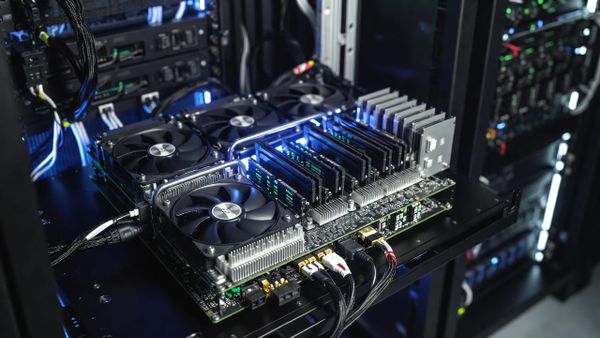
An expensive computing installation earns nothing while it waits for electricity. That makes the time between ordering power equipment and switching on a data center an investment variable in its own right. Bloom Energy's opportunity is to shorten that interval with modular fuel cells installed near the customer.
The stock now combines a substantial operating opportunity with a demanding valuation. The bullish case rests on repeatable deployment, profitable manufacturing and customers willing to pay for usable power sooner. A congressional disclosure and an index addition can draw attention to that case. They cannot substitute for the cash economics.
What the Pelosi filing actually says
Nancy Pelosi's August 21 periodic transaction report lists spouse-owned purchases of 15,000 Bloom shares across July 24 and July 28, plus 200 call-option contracts with a $100 strike and June 17, 2027 expiration. The four entries carry separate value bands: two at $1,000,001–$5 million and two at $500,001–$1 million. Added together, those bands span approximately $3 million–$12 million; the filing does not give an exact aggregate purchase cost. Original House disclosure, pages 1–2.
This is a dated household transaction disclosure, not a real-time portfolio or a finding about why the purchases occurred. It establishes neither privileged information nor the return another investor will earn. The distinction matters particularly with options: an exercise price is not the premium paid, and a later buyer faces a different price, remaining term and risk.
Electricity from fuel, without combustion
Bloom's Energy Server uses solid oxide fuel cells to turn the chemical energy in fuel into electricity through an electrochemical process. Cells are assembled into stacks, modules and larger installations. The system can use natural gas, biogas or hydrogen; natural-gas operation still produces carbon dioxide. It is an electricity generator requiring a fuel supply, rather than a battery storing previously generated electricity. Bloom's technology description.
The commercial attraction is modularity and proximity to demand. Customers can add capacity in stages and reduce dependence on the timing of new grid connections. That does not make fuel supply, site work, maintenance, permitting or redundancy disappear. A customer needs the complete system to operate reliably, including the supporting infrastructure.
An illustrative way to think about the economics is to compare the incremental cost of earlier power against the cash contribution from bringing computing capacity online sooner. If a facility could earn $10 million of monthly contribution after its other costs, avoiding a three-month delay would be worth up to $30 million before risk and financing adjustments. Those are hypothetical figures, not Bloom pricing or customer profitability estimates. They explain why the lowest equipment price need not produce the best project return.
The contracts have different levels of certainty
The April Oracle agreement is the clearest example. Bloom says Oracle intends to procure up to 2.8 GW, with an initial 1.2 GW contracted and deployment extending into 2027. The announcement also describes a prior Oracle installation completed in 55 days. That is evidence from a particular project, not a promise that every future site will operate on that schedule. Bloom–Oracle agreement, April 13.
Nebius provides evidence beyond one customer. Its May announcement outlined a first project with 328 MW expected to operate in 2026, replacing a planned combustion-based solution. The schedule remains a company expectation until commissioning is confirmed. Nebius announcement, May 20.
Financing capacity has expanded too. Brookfield's second-quarter shareholder letter says its framework with Bloom increased fivefold to invest up to $25 billion in behind-the-meter fuel-cell projects. That is a potential project-investment framework. It is not $25 billion of booked Bloom revenue, cash already received or a fully funded order backlog. Brookfield shareholder letter, page 4.
Bloom's August account of the Nebius project describes a $1.7 billion investment involving a developer, infrastructure capital, tax equity and senior debt. The useful inference is that deployment requires an ecosystem of financing and construction capabilities. It also means an equipment order can depend on other parties completing their own work. Bloom's project-financing account.
Investors should distinguish contracted equipment, optional procurement, financing frameworks, installation capacity and revenue recognition. These figures measure different things and may overlap. Adding the headline numbers together would overstate the business already secured.
The revenue outlook and its valuation hurdle
Second-quarter revenue was $1.065 billion, with 33.4% GAAP gross profit as a percentage of revenue, $182 million of operating profit and $226 million of operating cash flow. Management raised 2026 guidance to $3.9–$4.2 billion of revenue and $2.55–$2.85 of adjusted EPS. Its adjusted operating-income range is $800–$900 million. These forecasts imply a much stronger business than the prior year, but exclude expenses that affect GAAP results. July 28 earnings release.
At the September 9 intraday reference of $272.995, approximately 3:20 p.m. Eastern, the shares trade near 101 times the $2.70 midpoint of adjusted EPS guidance. Multiplying the price by June's 293.354 million shares gives an indicative $80.1 billion equity value, nearly 20 times the revenue-guidance midpoint. These are calculations from dated inputs, not a target price or a current consensus valuation.
June's balance sheet includes about $2.67 billion of cash, $2.48 billion of debt carrying value, $206 million of financing obligations and $126 million of operating leases. Quarterly diluted average shares were 323.331 million, materially above the period-end basic count. A full valuation must reconcile convertible debt, awards and warrants without counting both converted debt and the associated shares. Bloom's quarterly filing, financial statements and EPS note.
The following arithmetic illustrates the growth burden, starting from $4.05 billion of 2026 revenue. It is an analytical sensitivity, not management guidance, consensus or a forecast.
| Assumed annual revenue growth in both years | 2027 revenue | 2028 revenue |
|---|---|---|
| 30% | $5.27bn | $6.84bn |
| 50% | $6.08bn | $9.11bn |
| 70% | $6.89bn | $11.70bn |
Even the middle growth assumption leaves today's equity value around 8.8 times hypothetical 2028 revenue before future dilution. That arithmetic shows why execution and profit durability matter so much. Revenue could grow impressively while the shares disappoint if the valuation investors will pay contracts faster.
For example, 50% earnings growth combined with a move from 101 to 60 times earnings implies roughly an 11% price decline. The calculation is not a prediction. It demonstrates that a correct business thesis can still produce an unsatisfactory stock return from an expensive starting point.
An index catalyst, with an actual effective date
S&P Dow Jones Indices announced Bloom's addition to the S&P 500 on September 4, effective before the open on September 21, replacing Molson Coors. As of this article's cut-off, the addition is announced but has not taken effect. S&P's official announcement.
Index-tracking portfolios generally adjust to constituent changes. That can affect trading around a rebalance, but the announcement is public and other investors can anticipate it. Without a sourced estimate of tracking assets, free float and existing ownership, a precise forced-buying forecast would be false precision. Membership broadens the stock's benchmark relevance; it does not certify an attractive valuation.
What could undermine the case
Manufacturing scale, component availability, service costs and the customer's financing all deserve scrutiny. Bloom's July 9 filing rejected a short seller's accounting and scandium-supply claims and stated that it could meet current demand without dependence on China. That statement is management's response, not an independent audit of future supply. A supply-chain claim should ultimately be tested against deliveries and costs. Bloom's July 9 response.
Competition can also erode the premium for speed. If utilities, gas turbines, engines or other systems become available sooner or at better lifetime economics, customers have more alternatives. Conversely, continued delays elsewhere could extend Bloom's advantage. The correct comparison includes reliability, fuel, maintenance, emissions requirements and financing over the project's life.
The next two earnings reports should clarify conversion of announced capacity into recognized sales, service profitability, working-capital needs and cash after investment. Missed commissioning dates, repeated cost surprises or rising dilution without better cash per share would weaken the case. Reliable deployments across multiple customers and profitable repeat orders would strengthen it.
Bloom has a credible solution to an expensive infrastructure problem. The investment case rests on turning that solution into durable cash returns at a scale large enough to support an already substantial valuation.
Research note: Prepared with AI assistance. This article provides general information and investment analysis, not personalized advice. Prices are intraday references; company plans and illustrative scenarios are not guaranteed outcomes.