How Chevron is Turning an Oil Windfall Into Durable Cash Flow
Chevron’s enlarged production base and Microsoft power agreement broaden its opportunity. Sustainable cash per share remains the investment test.

Aria Vantage | September 9, 2026
Chevron's second quarter was exceptionally profitable. The investment question is whether its portfolio can support attractive shareholder returns when commodity prices retreat. A windfall helps: it creates cash to repay debt, fund projects and repurchase shares. It does not, by itself, establish that a stock is inexpensive. The stronger Chevron thesis rests on improved cash generation per share from an enlarged asset base, cost reductions and disciplined investment, with a developing power business providing an additional opportunity.
The oil backdrop and cash quality
The commodity backdrop still supports near-term earnings. In its September 9 outlook, the Energy Information Administration forecasts Brent around $90 a barrel in the second half of 2026 and an average of $74 in 2027 as supply recovers. Those figures are forecasts rather than live market prices. Their implication is that a valuation should survive a meaningful reduction in oil prices instead of requiring the second quarter's environment to persist. EIA September outlook
Chevron reported second-quarter net income of $12.1 billion, or $6.11 per diluted share, and adjusted EPS of $6.06. Production averaged 4.07 million barrels of oil equivalent a day, up 20% from a year earlier. It generated $22.6 billion of operating cash flow and spent $4.5 billion on capital projects. Its reported $18.1 billion of free cash flow included favorable working-capital effects; earnings also contained $1.4 billion of favorable timing effects. These qualifications matter when deciding how much of the quarter can recur. Chevron second-quarter results
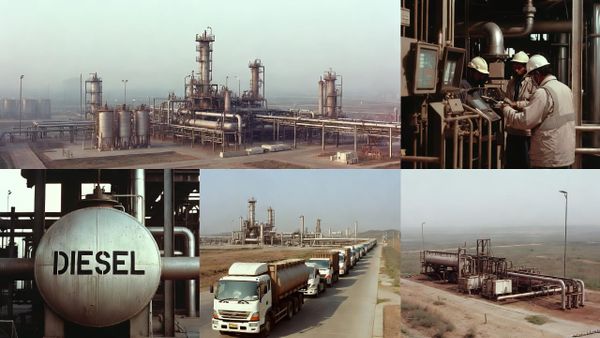
The business has several economic engines. Upstream operations produce oil and gas; downstream operations manufacture and sell fuels and other products. Integration can broaden the sources of earnings, but the segments do not reliably offset each other. Refineries may benefit from scarce diesel even when upstream growth slows; alternatively, both can suffer if demand falls far enough. The proper model separately estimates production, realized prices, refining economics and operating costs before aggregating them.
The production and productivity case
Hess materially changed the production base. Chevron's filing records the acquisition's July 2025 completion and explains that the transaction brought operations in Guyana, the United States and Malaysia. Acquisitions also bring additional shares, debt and depreciation. Investors therefore need to distinguish growth in total barrels from growth in cash per share. Chevron second-quarter filing, Note 18
The relevant promise is productivity: more distributable cash from each dollar of capital and each share outstanding. Management's November 2025 plan targeted production growth of 2%–3% annually through 2030 and more than 10% annual growth in EPS and adjusted free cash flow at $70 Brent. It also targeted a combined capital-spending and dividend breakeven below $50 Brent. These are company objectives under stated assumptions, not outcomes already secured. They remain useful benchmarks against which subsequent results can be tested. Chevron investor-day plan
The annual budget announced in December set consolidated organic capital spending at $18 billion–$19 billion for 2026, plus $1.3 billion–$1.7 billion of affiliate spending. The distinction matters: affiliate spending and Chevron's cash contributions are not interchangeable. The first-quarter presentation reaffirmed the consolidated range. The latest second-quarter release reported $8.6 billion of consolidated spending in the first half. Chevron capital budget, first-quarter presentation
A new power business
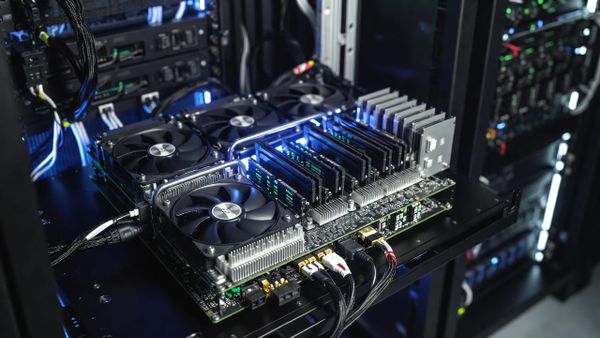
Power for data centers is a separate, potentially valuable development. In June, Chevron announced a 20-year agreement to supply a Microsoft data center in West Texas through Project Kilby. The planned facility would provide approximately 2.67 gigawatts through phased development, using gas turbines and related electrical infrastructure. Chevron's Microsoft agreement
The attraction is that a long-lived customer contract can support an investment decision more directly than a forecast of spot electricity demand. The unanswered valuation questions are the capital required, price escalation, fuel-cost allocation, construction risk and cash left after financing. A gigawatt announcement is not a profit forecast. This article assigns no incremental project value without a supported cash-flow and financing model.
Investors should also avoid assuming that dedicated generation removes every development constraint. Texas's August 3 directive requires an audit of data centers proceeding through ERCOT's interconnection process, covering power, water and other project details. The scope of the directive must be evaluated for each project; it does not prove that Kilby is approved, exempt or blocked. Texas data-center audit directive
Valuation through the commodity cycle
At the observed September 9 intraday reference of $214.06, approximately 3:50 p.m. Eastern, Chevron's 1.962 billion quarter-end shares excluding its benefit-plan trust imply equity value near $420 billion. Debt and finance leases of $37.1 billion less $8.5 billion of cash, deposits and marketable securities imply net debt of $28.6 billion. Adding that produces roughly $448.6 billion before noncontrolling interests and other enterprise-value adjustments. This is a dated capitalization bridge, not a fully diluted valuation. Chevron quarterly filing, share-count reconciliation
The declared quarterly dividend of $1.78 annualizes to $7.12, a yield of approximately 3.33%. Annualizing second-quarter adjusted EPS would imply a P/E of 8.8; annualizing first-half adjusted EPS produces about 14.3. Neither is a forward consensus multiple. The gap demonstrates how dramatically the conclusion changes with the measurement window. Chevron second-quarter results
A better valuation debate begins with sustainable cash. On $420 billion of equity value, a 6% cash yield requires approximately $25.2 billion annually after capital investment and before distributions to common shareholders. That is a chosen analytical hurdle. A complete model would reconcile affiliate distributions, working capital, acquisitions, minority claims and financing rather than simply multiply one quarter by four.
| Illustrative annual cash available to common equity | Yield on reference equity value | Required operating setting |
|---|---|---|
| $18 billion | 4.3% | Lower commodity realizations and refining profits outweigh operational gains |
| $25 billion | 6.0% | Production and cost progress support cash through normalization |
| $32 billion | 7.6% | Favorable commodities combine with reliable execution |
These are sensitivity assumptions, not company guidance, analyst consensus or price targets. The middle case does not receive a probability merely because it sits between the others. The table shows the scale of cash generation needed to support different investor expectations.
What could weaken the case
The principal downside is a simultaneous deterioration in prices and execution. A lower oil price is manageable if investment discipline and cash productivity improve enough; it becomes more damaging if projects also miss expectations. International assets bring operating, transport and fiscal exposures. Additional cash commitments to power facilities can also reduce distributions before the new assets contribute earnings. A dividend is part of total return, not protection against any purchase price.
Over the next two reporting cycles, the clearest tests are production excluding acquisition comparisons, cash flow excluding working-capital swings, capital spending and cash per share. Project Kilby's terms and construction milestones should be monitored separately. The case strengthens if Chevron retains the financial benefit of this year's windfall and delivers better underlying cash economics as oil normalizes. It weakens if strong headline production masks disappointing returns on the capital and shares used to acquire it.
Research note: Prepared with AI assistance. This article is informational and is not personalized investment advice. Data are current to the dated sources shown. Valuation calculations use the dated inputs shown; cash-flow sensitivities are illustrative.