Micron Leading HBM - AI’s Memory Bottleneck Meets the Test of Durability
HBM4, longer customer agreements and manufacturing expansion support Micron’s AI opportunity. The key test is how durable today’s earnings become.

Aria Vantage | Research cut-off: September 9, 2026
Micron’s investment case turns on a deceptively simple question: how much of today’s extraordinary profitability can survive the next wave of supply? AI creates a compelling reason to own the memory value chain. It does not abolish the difference between a scarce component and a permanently scarce component.
The strongest bullish argument is that memory is becoming a more specialized, jointly engineered part of computing infrastructure. If that transition supports longer customer commitments and stronger returns on manufacturing investment, Micron could deserve a different valuation than a supplier whose earnings depend almost entirely on the next commodity-price turn. That remains a proposition to test, rather than a transformation to declare complete.
The memory opportunity
The latest reported quarter shows why the debate matters. Fiscal Q3 revenue reached $41.46 billion; GAAP diluted earnings were $24.67 per share, versus $25.11 adjusted. Management’s subsequent Q4 guidance calls for $50 billion of revenue, plus or minus $1 billion, and roughly 86% gross profit as a percentage of revenue. These are reported results followed by company forecasts, respectively. Micron’s June 24 results.
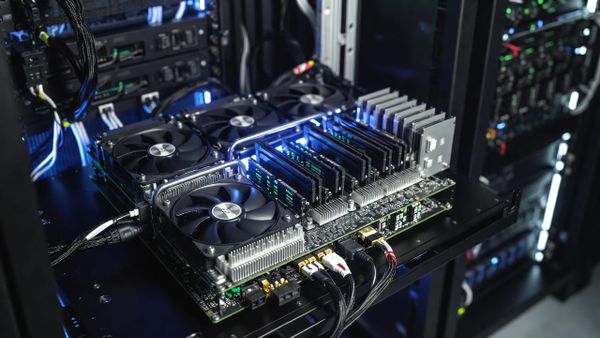
Memory determines both how much information a system can hold close to its processors and how quickly the processors can access it. High-bandwidth memory, or HBM, stacks memory dies and uses a wide interface to move data. Its value is especially clear when expensive accelerators would otherwise wait for information. Capacity and bandwidth solve different problems: more capacity accommodates larger working sets, while more bandwidth feeds computation faster. Micron’s HBM technology overview.
Micron announced volume shipments of its 36GB, 12-high HBM4 for NVIDIA’s Vera Rubin platform in March. It claims more than 2.8 terabytes per second of bandwidth and over 20% better power efficiency than its comparable HBM3E product. Those performance comparisons are manufacturer claims. The same announcement covered SOCAMM2 memory modules and PCIe Gen6 data-center storage, showing that Micron’s opportunity extends beyond memory beside the GPU. Micron’s product announcement.
The investment implication is broader than winning one component socket. A data-center operator purchases useful computation, and poor memory or storage performance can reduce the return on an entire system. Suppliers that improve those economics may negotiate from a stronger position. But system importance alone does not establish pricing power: customers can still qualify alternatives, redesign systems, or divide orders among suppliers.
Customer demand and longer contracts
Demand evidence also comes from the buyers. Microsoft reported $41 billion of quarterly capital expenditures, with about two-thirds going toward shorter-lived assets, primarily CPUs and GPUs. It expects fiscal 2027 capital spending to increase. This supports continued infrastructure demand, although Microsoft’s spending is neither entirely AI-related nor a direct forecast of Micron orders. Microsoft’s July earnings call.
The emerging contract structure deserves at least as much attention as HBM specifications. Micron’s latest filing describes multiyear take-or-pay agreements with binding volumes; most have fixed prices or price bands. The disclosed remaining performance obligations exclude some contracts and therefore are not a complete forecast of future sales. Micron’s fiscal Q3 Form 10-Q, Note 14.
These agreements can make investment planning more credible by assigning some demand risk to customers. They cannot remove counterparty risk, implementation disputes, product-transition requirements, or the economic consequences of an industry downturn. A price floor is valuable only in relation to the cost of delivering the promised product. Investors should ask how much future output is covered, whether terms protect returns after manufacturing costs, and how new generations are repriced.
The change is not confined to hyperscalers. Micron’s July automotive agreements include suppliers such as DENSO, Visteon and Hyundai Mobis, with stated objectives of improving supply and pricing visibility. Automotive memory has a different qualification timetable and product life from frontier AI hardware. That can broaden the customer base, but vehicle production remains an independent cyclical exposure. Micron’s automotive agreements.
The next wave of supply
Competition supplies an essential check on the scarcity argument. SK hynix says it began HBM4 mass shipments in the second quarter and plans to increase production in the second half. It also reports long-term agreements with about ten customers and describes additional capacity projects. The industry is responding to attractive economics. Micron must win on delivery, quality and cost while that response develops. SK hynix’s July 29 results.
The bullish interpretation is that demanding customers support a larger, more valuable market for multiple suppliers. The bearish interpretation is that current profitability finances the capacity that eventually erodes it. Both can be true at different points in the cycle. A strong technology franchise needs to earn its return through that transition, not merely during the shortage preceding it.
Micron’s manufacturing program makes this tension concrete. In July, the company increased planned U.S. investment to more than $250 billion through 2035, with first wafer output expected in mid-2027 at its first new Idaho fab and late 2028 at the second. These are investment plans and production milestones, not completed capacity or guaranteed returns. Micron’s July manufacturing update.
A broader manufacturing footprint can give customers additional sourcing options. For shareholders, the more demanding test is whether each expansion earns enough after construction, equipment, operating costs and subsequent reinvestment. A project can increase productive capacity while reducing near-term free cash flow. Announced spending should never be added to revenue forecasts as though dollars invested automatically create dollars of profitable demand.
Valuation and earnings durability
At the September 9 intraday reference price of $1,027.09, approximately 3:50 p.m. Eastern, Micron traded at about 10.4 times four times its latest quarterly GAAP EPS. That is annualized-quarter arithmetic, not a forward consensus multiple. If those earnings were cut in half, the same price would represent about 20.8 times the reduced annual earnings. The apparent bargain depends heavily on the denominator.
For context, Stock Analysis’s public forecast page, accessed September 9, showed revenue estimates of $129.74 billion for FY2026 and $241.08 billion for FY2027. These third-party estimates already anticipate major expansion. The page also displays EPS forecasts, but its accessible presentation did not resolve the accounting basis sufficiently to use them here as a comparable valuation anchor. Public estimate snapshot.
Scenarios and the September checkpoint
Our bullish scenario requires successful product ramps, customer commitments that protect economic returns, and cash generation that remains strong after expansion spending. A middle scenario has rising volumes offset by normalizing prices and heavier investment. A bearish scenario combines new industry capacity, weaker customer orders and fixed manufacturing costs; profits could fall faster than revenue. These are analytical scenarios, not probability estimates or price targets.
The next concrete checkpoint is September 30, when Micron has scheduled its fiscal Q4 results call. Readers should watch the following-year outlook, pricing versus shipment growth, customer-contract disclosures, manufacturing spending and cash conversion. A technology delay, deteriorating contract economics, or sustained expansion without satisfactory cash returns would weaken the case even if headline sales continued growing. Micron’s earnings announcement.
Micron offers a credible way to participate in the memory requirements of AI. The potential mispricing is a more durable earnings base than the market assigns to a memory cycle. Its reported operating performance supports that argument. Long-term normalized profits and returns on the full manufacturing program will determine how much of the opportunity reaches shareholders.
Research note: This article was prepared with AI assistance. It provides general information and analysis, not personalized investment advice. Prices, forecasts and company plans can change.