Amazon’s $220 Billion Bet Is Bigger Than Cloud

The market celebrated accelerating AWS growth. The more important story is that Amazon is assembling a system spanning compute, commerce, logistics, advertising, healthcare, chips, satellites and autonomy.
Amazon added roughly $388 billion of market value on July 31 because investors saw what they had been demanding: evidence that enormous artificial-intelligence spending can produce enormous operating results.
The shares jumped 15.3% after the company reported second-quarter revenue of $200.6 billion, up 20% from a year earlier and above the roughly $197 billion analysts expected. Operating income rose 43% to $27.5 billion. AWS revenue accelerated 37% to $42.2 billion, while the segment generated $16.6 billion of operating income—an implied margin of 39.4%.
The headline was cloud. The thesis is much larger.
Amazon is often valued as two businesses: a retailer and a cloud provider. That framework misses the architecture being built around them. The company has become a stack of interlocking platforms—logistics, payments, advertising, video, pharmacy, enterprise procurement, custom silicon, robotics, satellite connectivity and autonomous transport—each feeding data, demand or infrastructure into the others.
The market is beginning to price that system. It may not yet price all of it.
The quarter versus expectations
Amazon’s official results showed:
- Net sales of $200.61 billion, up 20%.
- Operating income of $27.46 billion, up 43%.
- North America sales of $116.18 billion and operating income of $9.12 billion.
- International sales of $42.20 billion and operating income of $1.72 billion.
- AWS sales of $42.23 billion and operating income of $16.62 billion.
- Trailing operating cash flow of $161.4 billion, up 33%.
GAAP net income was $62.65 billion, or $5.75 a share, versus $18.16 billion and $1.68 a year earlier. That profit should not be read as a clean tripling of the operating business. Amazon recorded $53.4 billion of non-operating income, largely from investment marks. Operating income and cash flow provide the better comparison.
The market understood the distinction and rallied anyway, because the core result was strong enough without the accounting windfall.
The empire hiding in plain sight
AWS remains the profit engine, but Amazon’s other businesses are not side projects.
Advertising monetizes high-intent shopping traffic and supplies a high-margin profit stream that helps fund fulfillment and media.
Logistics has evolved from a retail cost center into a strategic network of warehouses, aircraft, last-mile delivery and robotics that can move more products faster and lower the unit cost of convenience.
Amazon Business reached a $60 billion annualized gross-sales run rate. That is an enterprise procurement platform embedded inside the broader marketplace.
Healthcare is becoming a real distribution system. Amazon said new pharmacy customers doubled in the first half and same-day prescription deliveries increased roughly fivefold.
Instant commerce is scaling quickly. Amazon Now grew gross sales and units 80% sequentially, expanded customers by 60% and reached more than 250 cities across nine countries.
Connectivity and autonomy create longer-dated options. Amazon Leo has nearly 400 satellites in orbit, while Zoox received U.S. approval to begin paid rides. Neither needs to justify today’s valuation to matter; each expands the set of markets Amazon can attack with infrastructure it already knows how to build.
The common thread is not that Amazon “does everything.” It is that the company repeatedly turns fixed infrastructure into a platform, then layers higher-margin services on top.
The $220 billion question
Amazon raised its 2026 investment plan to approximately $220 billion from $200 billion, compared with $128 billion last year. The spending covers AI data centers, custom chips, robots, fulfillment capacity and satellites.
That scale is both the bull case and the risk.
Trailing purchases of property and equipment, net of proceeds, reached $169.0 billion. Trailing free cash flow fell to negative $7.6 billion from positive $18.2 billion a year earlier. Management is choosing capacity over near-term cash harvesting.
The optimistic reading is that 37% AWS growth and higher operating margins prove demand is arriving ahead of capacity. The cautious reading is that today’s cloud revenue must support an investment program larger than the annual sales of most public companies.
The right answer is to monitor the conversion: incremental revenue, incremental operating income and eventual free cash flow for every new dollar of capital.
Earnings and valuation trends
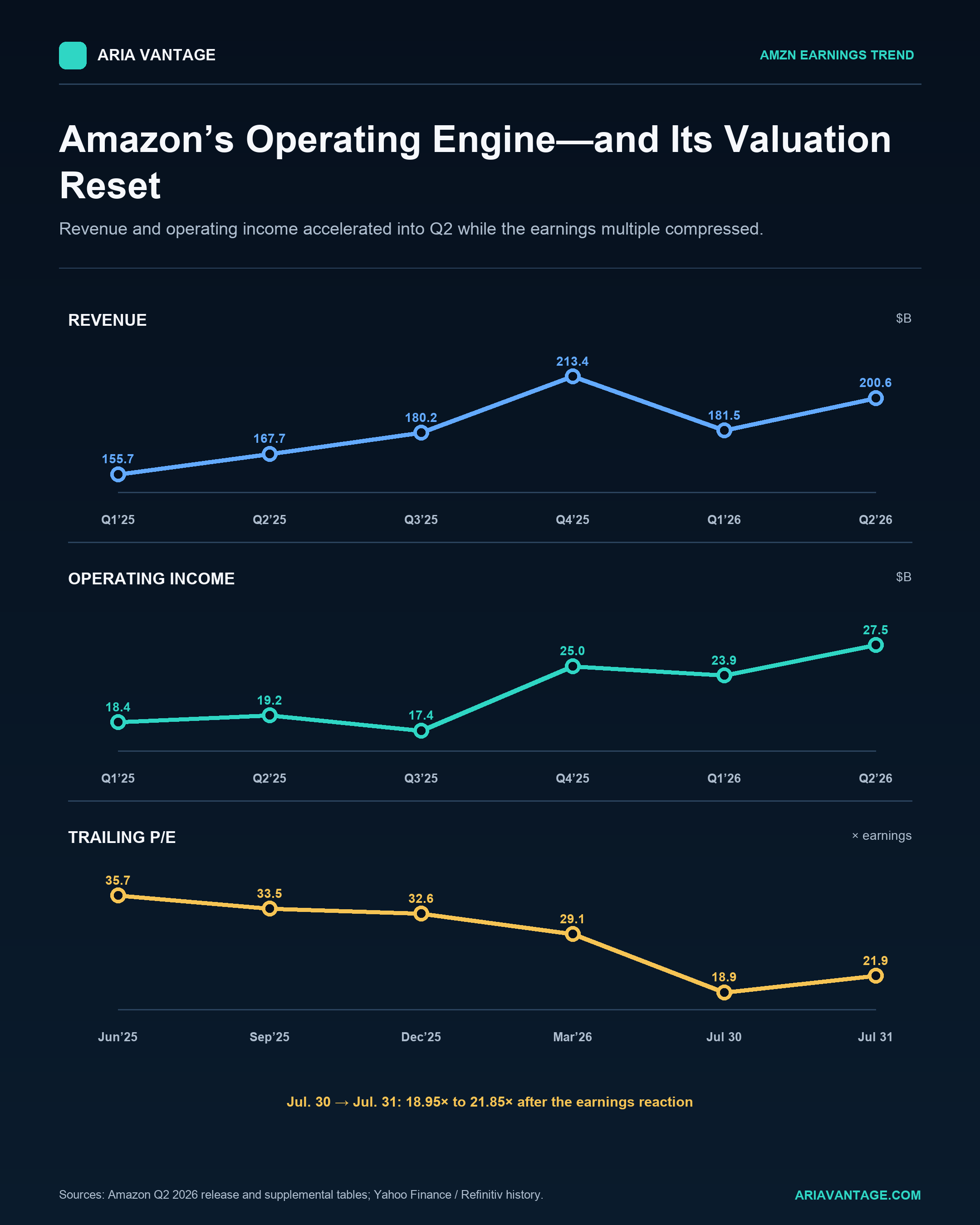
Amazon’s quarterly revenue rose from $155.7 billion in Q1 2025 to $200.6 billion in Q2 2026. Operating income increased from $18.4 billion to $27.5 billion over the same period, with normal seasonality in between. GAAP EPS moved from $1.59 to $5.75, but Q2 2026’s investment marks make that last step incomparable.
Yahoo Finance’s quarterly valuation history, using Refinitiv data, showed trailing P/E declining from 35.7 times in June 2025 to 29.1 times in March 2026 and about 19 times immediately before the earnings rally. After the July 31 price jump, the trailing multiple was roughly 21.9 times. Forward P/E moved from about 34.0 times to the high-20s.
Those figures require context. The unusually large non-operating gain depresses the trailing P/E. For this quarter, investors should place more weight on AWS growth, operating income and normalized cash economics than on the headline multiple.
What the market expects next
For the third quarter, Amazon guided to net sales of $197 billion to $202 billion, representing reported growth of 9% to 12%. The timing of Prime Day reduces the comparison by roughly four percentage points, and foreign exchange is expected to be an 80-basis-point headwind. Operating income is expected between $22.5 billion and $26.5 billion.
Investors should watch five items:
- AWS growth and backlog: Can the 37% pace persist as new capacity comes online?
- Capital intensity: Does the $220 billion plan peak, or become a new floor?
- Free-cash-flow conversion: When do the assets move from construction to revenue-generating service?
- Retail margin: Can faster delivery and robotics expand profit without sacrificing selection or price?
- The option portfolio: Advertising, pharmacy, Business, Leo and Zoox need clear milestones, not just narratives.
Amazon’s competitive advantage is no longer any single business. It is the ability to finance, connect and compound many businesses on a shared infrastructure base.
The market rewarded the first proof of that model’s next phase. The $220 billion bill means proof will be required every quarter.
Disclosure: This article was partially produced with the assistance of AI tools and was reviewed and edited before publication. The author held a long position in AMZN as of July 31, 2026. The author also held long positions in MSFT and GOOGL, companies that compete with Amazon in cloud computing and other markets. The author received no compensation from the companies mentioned. This material is for informational purposes only and is not investment advice.