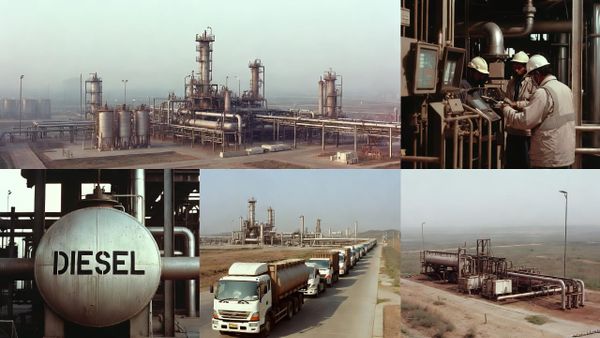
Hormuz Is a Physical Market Again
U.S.-Iran missile barrages resumed as weekly Hormuz vessel passages fell from 82 to 39. Brent itself settled at $86.88 per barrel.

Political-market analysis, verified through July 30, 2026. The Strait of Hormuz is no longer trading as a geopolitical possibility. It is trading as impaired infrastructure.
The United States and Iran exchanged missile barrages Thursday after a brief pause in fighting. Jordan said it intercepted five Iranian missiles; Kuwait reported that a strike killed one person. U.S. Central Command said American forces conducted a “heavy wave” of strikes against dozens of Islamic Revolutionary Guard Corps targets, including command centers, missile and drone facilities, and coastal surveillance and defense sites. Iranian state media said three people were killed on Qeshm Island.
The same week brought U.S.-Saudi strikes on Iran-backed militia sites in Iraq, drone-caused fires aboard two gas vessels at Egypt’s Damietta port, and attacks claimed or attributed across routes that were supposed to relieve pressure on Hormuz. Every battlefield claim deserves attribution. The market consequence is easier to verify: fewer ships are moving.
The oil risk is now measured in hulls
Lloyd’s List Intelligence counted 82 vessel passages through Hormuz during the week of July 13–19 and 39 vessel passages during July 20–26. The figure 39 is a count of ships, not an oil price; Brent settled Thursday at $86.88 per barrel. Before the war, roughly one-fifth of global oil and natural-gas shipments passed through the strait. Saudi Arabia has diverted some crude toward the Red Sea, but Houthi threats around Bab el-Mandeb and drone attacks on Saudi energy infrastructure have made that route less dependable as well.
Some barrels now take an expensive relay: tanker to Egypt’s Red Sea coast, overland pipeline to the Mediterranean, then another tanker. The Suez Canal cannot handle the largest fully loaded crude carriers. This is not a theoretical risk premium. It is more ships, more handling, more insurance and more time for each delivered barrel.
Brent settled 1.4% lower Thursday at $86.88, one day after jumping 7.3%. It traded as low as roughly $72 early this month and as high as $102 last week. That range shows how quickly the market toggles between diplomatic hope and physical disruption.
Why a pause is no longer enough
Negotiations can reduce the oil premium, but markets will be reluctant to trust communiqués while missiles are directed at bases, drones strike energy facilities and commercial routes remain bargaining chips. A credible de-escalation now requires observable conduct: sustained vessel transits, lower war-risk insurance, an end to attacks on shipping and a verifiable reduction in launch activity.
This does not mean diplomacy is futile. It means the burden of proof has moved from words to water. The distinction also applies to Israel’s security. Any arrangement that reopens commerce but leaves Israel, U.S. forces or Gulf states under recurring missile attack merely transfers risk from the tanker route to the next round of escalation.
The strongest regional outcome would protect international navigation, reduce attacks on civilians and military bases, and create enforceable limits that do not depend on trust in any one government’s rhetoric. That is a more durable pro-American and pro-Israeli position than celebrating escalation for its own sake.
How the shock reaches XOM, CVX and VLO
Exxon Mobil and Chevron: Higher realized oil and gas prices can support upstream cash flow. Their global portfolios, trading operations and integrated refining systems also provide options when one route is impaired. U.S. production becomes more strategically valuable when imported supply is unreliable.
The favorable case is not automatic. Both companies operate in a world of physical cargoes, personnel and infrastructure. Disrupted liftings, higher freight, political pressure over gasoline and abrupt price reversals can offset part of the upstream gain. Their earnings calls Friday should be judged on volumes, realized pricing and capital discipline—not the spot price alone.
Valero: VLO has a different exposure. As a refiner, it buys crude and sells gasoline, diesel and other products. Higher crude is not inherently bullish. The opportunity depends on crack spreads, feedstock discounts, utilization and whether product shortages allow refiners to pass through costs. Route disruptions can widen regional price differences that skilled operators monetize, but they can also reduce throughput or demand.
Energy Transfer: Domestic pipelines and storage gain strategic relevance when seaborne routes become unreliable. Yet volumes, contract terms and regional bottlenecks matter more than a simple “oil up” thesis.
The market transmission map
Fewer Hormuz transits raise freight and insurance costs. Those costs lift delivered energy prices. Higher energy feeds inflation expectations and long-term bond yields. Higher yields pressure equity valuations and household demand. At the same time, U.S. producers, certain refiners and domestic midstream networks can gain relative value.
The second-order effects are just as important: airlines pay more for fuel; petrochemical feedstocks rise; fertilizer and shipping costs increase; importers weaken; governments consider releases from strategic reserves or price interventions. An oil shock that lasts days is a trade. One that lasts months becomes macro policy.
What is priced in
With Brent near $87 after touching $102, the market has priced significant disruption but not a permanent loss of Gulf exports. The residual opportunity in U.S. energy depends on duration. If transits normalize and war-risk premiums fall, crude could give back quickly. If the weekly ship count remains depressed or Bab el-Mandeb tightens further, today’s price may understate the logistics problem.
The cleanest indicators are not political adjectives. They are ship counts, insurance quotes, tanker rates, export loadings and inventories. Peace will be visible there before it is trusted on a podium.
Sources and methodology
- July 30 U.S.-Iran strikes, casualties and Hormuz traffic
- Reuters: Hormuz traffic and maritime risk
- Iran International: U.S.-Iran conflict and attacks on Gulf facilities
- July 30 Brent settlement and monthly range
- U.S. Central Command public account
Official statements, Reuters and established reporting were used for factual claims. The public accounts of CENTCOM, Jason Brodsky, OSINT613 and other user-specified OSINT feeds were monitored for leads; unverified footage, anonymous casualty claims and unattributed battlefield claims were not treated as confirmed evidence.
Author positions: The author holds long positions in XOM, CVX, VLO and ET. Compensation: Neither Aria Vantage nor the author received compensation from any issuer or third party in connection with this article. Conflict involves death, injury and civilian hardship; those consequences should not be reduced to an investment theme. This article contains analysis and opinion. It is general market commentary for informational and educational purposes, not individualized investment advice or a recommendation. Read the full disclosures.