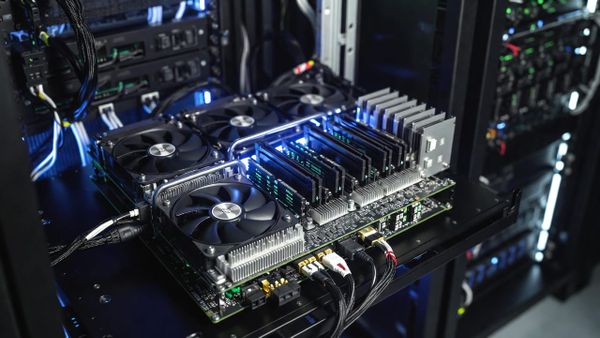
The Chip Selloff That Mistook Scarcity for Symmetry
Micron’s 10% drop says peak cycle. Its HBM4 ramp, binding agreements through 2030 and record guidance say the market may be using the wrong map.

Market close, July 29, 2026. Micron fell 9.9% to $739.00 and Nvidia lost 3.6% to $190.01 as investors punished the semiconductor complex. The easy interpretation is that the memory cycle has peaked. The more interesting possibility is that the market confused a violent valuation reset with a change in the scarcity economics.
That distinction matters because Micron is no longer selling interchangeable memory into an ordinary PC cycle. It is increasingly selling a power-constrained, packaging-intensive component of the AI factory.
The technology edge is becoming measurable
Micron began high-volume shipments of its 36-gigabyte, 12-high HBM4 in early 2026 for Nvidia’s Vera Rubin platform. The company says the part delivers 2.3 times the bandwidth of its HBM3E generation while improving power efficiency by more than 20%. Its fiscal third-quarter presentation also said the HBM4 ramp was progressing twice as fast as its earlier 12-high HBM3E ramp.
That does not prove Micron leads every competitor on every specification. Samsung and SK Hynix remain formidable. It does, however, establish a credible lead where hyperscalers care most: qualified production, bandwidth, thermals and time-to-volume. Micron is already shipping HBM4 from its 1-beta process and plans HBM4E on 1-gamma in calendar 2027. In a market where a late qualification can cost a customer an entire accelerator cycle, execution is a competitive feature.
The separation may happen slowly. Rivals tempted to chase today’s extraordinary pricing with undisciplined capacity could be burned when those additions arrive. Micron’s better route is to convert scarcity into durable customer commitments while moving its mix toward HBM and advanced data-center products. South Korea’s SK Hynix fell 9.6% today even after reporting record revenue and profit—a useful reminder that the market now demands flawless growth, not merely excellent results.
What Micron actually said about demand
The shorthand circulating online—that Micron is “fully booked through 2027”—is too broad. The current disclosure is more nuanced and, arguably, more powerful. Management said DRAM and NAND demand significantly exceeds available supply, conditions should remain tight beyond calendar 2027, and even with improving supply in 2028 it does not yet see demand catching up.
Micron has signed 16 strategic customer agreements, generally covering five years from 2026 through 2030. Fourteen carry roughly $100 billion of minimum purchase commitments, supported by about $22 billion of customer deposits and other commitments. These agreements cover around 20% of expected DRAM volume and one-third of NAND volume over their lives. That is not every wafer pre-sold; it is a meaningful floor under a growing portion of the business.
Apple did not raise prices because of Micron alone
Apple’s June increases on MacBooks and iPads were tied to soaring memory and storage costs. Reuters reported that memory producers, including Micron, had prioritized high-value AI demand, tightening supply for consumer devices. So Micron helped force the issue, but it did not act alone. Industry-wide scarcity—not a unilateral Micron decision—reached the consumer’s receipt.
That episode is important because it demonstrates pricing power migrating upstream. When one of the world’s best supply-chain operators can no longer fully absorb component inflation, the memory vendors have gained leverage.
A larger quarter—and a valuation with an asterisk
Micron’s fiscal third quarter was already extraordinary: revenue reached $41.46 billion, adjusted gross margin was 84.9%, and non-GAAP earnings were $25.11 per share. Management guided the fourth quarter to $50 billion of revenue, plus or minus $1 billion, approximately 86% adjusted gross margin and $31.00 of non-GAAP earnings per share, plus or minus $1.00.
In other words, the quarter Micron is preparing to report is expected by management to be larger than the record it just delivered—roughly 21% more revenue and 23% more adjusted earnings per share at the midpoint. At today’s close, Yahoo Finance showed a trailing P/E of 18.55 and a forward P/E near 5.3. If $31 of quarterly earnings were simply annualized, the resulting run-rate multiple would be below 6. That is not a forecast: memory earnings are cyclical, and annualizing a peak-margin quarter can be dangerously flattering. But it shows how much earnings deterioration the current multiple already assumes.
The opportunity is favorable, not effortless. Export controls, customer concentration, power constraints, competitive capacity and a sudden pause in AI spending could all break the thesis. The bull case is that Micron is using today’s shortage to lock in tomorrow’s customers while its technology catches up—or pulls ahead—faster than the market’s cycle model can recognize. After a 10% one-day decline, that asymmetry deserves attention.
Sources
- Micron fiscal Q3 2026 results and Q4 guidance
- Micron fiscal Q3 prepared remarks
- Micron HBM4 production announcement
- Reuters: Apple pricing and memory costs
- Yahoo Finance: MU market data
Author positions: The author holds long positions in MU, NVDA and AAPL. Compensation: Neither Aria Vantage nor the author received compensation from any issuer or third party in connection with this article. This is general market commentary for informational and educational purposes, not individualized investment advice or a recommendation. Prices and estimates are as of the July 29, 2026 close unless otherwise stated. Read the full disclosures.