Amazon’s Two Engines and One Giant Check
Retail is producing cash, AWS is accelerating and AI capex is consuming nearly all of the free cash flow. Tomorrow’s report will test the return on the build.

Amazon will report second-quarter results after the bell on July 30 with the stock at $226.65, down 1.8% for the day and roughly 2% over both the year to date and the past 12 months. That flat performance conceals a company whose operating structure has changed dramatically.
Amazon is still the world’s most consequential online retailer. It is also a logistics network, an advertising platform, a subscription bundle, a third-party marketplace and the largest public cloud provider. The market’s immediate question is whether the company’s enormous AI investment is consuming cash faster than those engines can replenish it. The longer-term question is what happens if the investment works.
Retail is no longer merely a scale story
First-quarter net sales rose 17% to $181.5 billion. North American sales increased 12% to $104.1 billion, while international sales rose 19% to $39.8 billion. More important, the segments produced $8.3 billion and $1.4 billion of operating income, respectively, versus $5.8 billion and $1.0 billion a year earlier.
Years of regionalizing fulfillment, improving inventory placement and increasing delivery speed have turned retail from a growth-at-any-cost machine into a cash-producing distribution system. Advertising adds a high-margin revenue stream at the moment of purchase, and management says advertising surpassed a $70 billion trailing-12-month run rate. Prime subscriptions deepen loyalty while marketplace services let Amazon earn fees without owning every item it sells.
This is what makes Amazon’s revenue unusually rich: the same customer visit can generate product revenue, a third-party fee, an advertisement, a subscription benefit and a logistics charge. Few businesses can monetize the same transaction from so many directions.
AWS remains the gold inside the conglomerate
AWS first-quarter sales grew 28% to $37.6 billion, the segment’s fastest growth in 15 quarters. Operating income rose to $14.2 billion from $11.5 billion. AWS represented only about one-fifth of consolidated revenue but nearly 60% of segment operating income before corporate and other items.
The cloud is attractive not only because it grows faster. It is the infrastructure layer for databases, storage, cybersecurity, analytics and generative AI. Amazon says its Trainium and Graviton chips have exceeded a $20 billion annual revenue run rate and are growing at triple-digit rates. Customer spending through Bedrock increased 170% sequentially, while usage in the first quarter exceeded that of all prior years combined.
That is the gold: a high-margin utility whose customers build on top of it, making workloads sticky and future services easier to sell.
The giant check
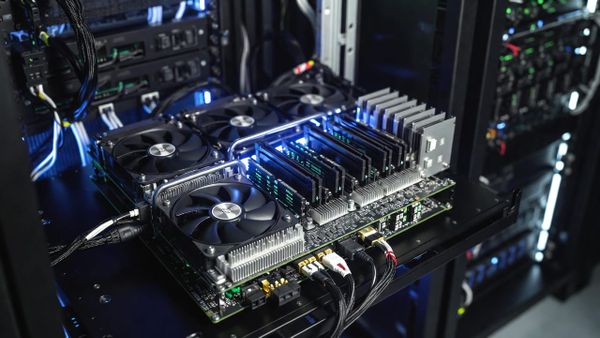
The cost of this opportunity is visible in free cash flow. Trailing-12-month operating cash flow rose 30% to $148.5 billion, yet free cash flow fell to $1.2 billion from $25.9 billion. Purchases of property and equipment increased by $59.3 billion, primarily for AI infrastructure. Amazon expects roughly $200 billion of capital spending in 2026.
That number is intimidating, but capex is not the same as an operating loss. The servers, chips, data centers and power connections become capacity Amazon can rent for years. If AI demand compounds, today’s spending creates tomorrow’s revenue bottleneck and widens AWS’s moat. If demand disappoints, utilization falls and depreciation arrives anyway. The debate is therefore less “Is $200 billion too much?” than “What return will Amazon earn on the installed base?”
The earnings setup and valuation
Amazon guided second-quarter sales to $194 billion to $199 billion, implying 16% to 19% growth, and operating income to $20 billion to $24 billion versus $19.2 billion a year ago. Its first-quarter net income of $30.3 billion included a $16.8 billion pre-tax gain related to its Anthropic investment, so headline earnings should not be mistaken for purely recurring operations.
At today’s close, Yahoo Finance showed a trailing P/E of 27.1. That is not cheap in isolation, but it is far removed from the triple-digit multiples once associated with Amazon. The multiple now sits on top of expanding retail margins, fast-growing AWS, a large advertising business and an option on AI economics. It also sits on top of substantial depreciation, regulatory risk and a capital program with little room for error.
Tomorrow’s best signal may not be a single earnings beat. Watch AWS growth, operating margins, capex timing, backlog and management’s language on power availability. Amazon’s appeal is that AI does not have to carry the company by itself. Retail, marketplace, advertising and subscriptions already generate diversified growth. If the AI build pays off, AWS could turn that diversity into something much larger.
Sources
- Amazon first-quarter 2026 results and second-quarter guidance
- Amazon second-quarter 2026 earnings event
- Amazon 2025 annual report
- S&P Global Market Intelligence: Amazon earnings preview
- Yahoo Finance: AMZN market data
Author positions: The author holds a long position in AMZN. Compensation: Neither Aria Vantage nor the author received compensation from any issuer or third party in connection with this article. This is general market commentary for informational and educational purposes, not individualized investment advice or a recommendation. Prices and estimates are as of the July 29, 2026 close unless otherwise stated. Read the full disclosures.